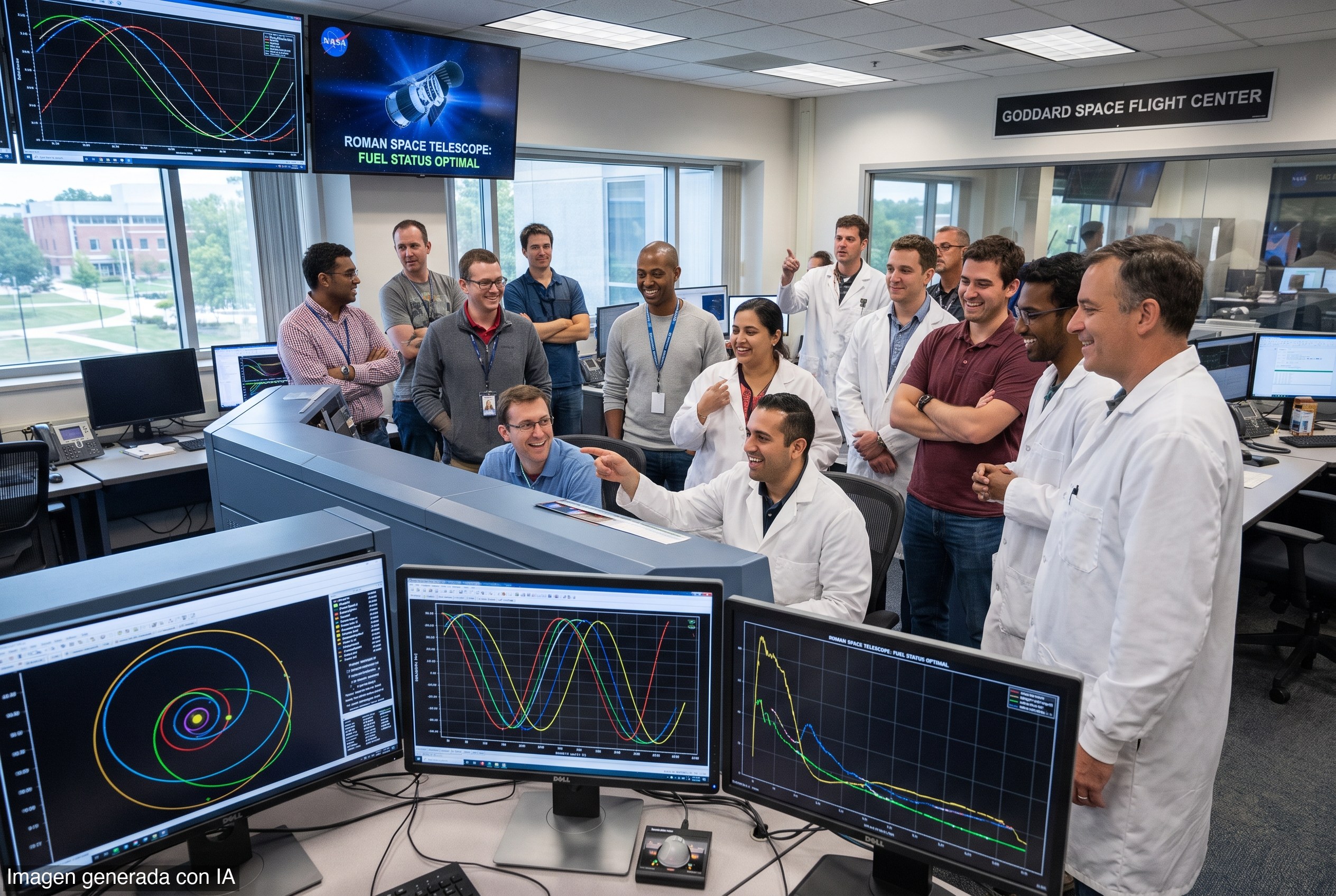
NASA says its Nancy Grace Roman Space Telescope now has fuel for at least 22 years of potential science operations, about double the agency's original expectation.
The observatory launched on August 30 aboard a SpaceX Falcon Heavy from NASA's Kennedy Space Center in Florida. Its job is ambitious: map a wider view of the Universe, study dark energy, and search for exoplanets.
The fuel math changed because the spacecraft came in lighter than planners expected. Roman's actual weight at completion was 17,760 pounds, roughly two tons below its maximum allowable weight. That let ground crews load 290 gallons of hydrazine, more than engineers had anticipated early in the design phase.
Then came the burn that made the difference. One day into the mission, Roman fired its control thrusters for the first big course correction. NASA said that maneuver used just 40 pounds of hydrazine, far below the preflight allocation of 441 pounds. Jamie Dunn, the center director at NASA's Goddard Space Flight Center, said in a press release that 'as a result of exquisite planning by our orbital dynamics team, brilliant execution by the operations team, and a precise launch from SpaceX, Roman has fuel for at least 22 years of potential science operations.'
Alison Rao, Roman's propulsion lead at NASA Goddard, said the agency budgets propellant against a maximum mass so it does not come up short. Because Roman ended up lighter, NASA was able to fill the tanks to capacity rather than only to meet the 10-year requirement.
A second course correction later this month is expected to use less fuel than planned as well, and NASA says that could leave even more propellant for future science. Once Roman reaches its final orbit around the Sun-Earth L2 Lagrange point, it will need only station-keeping burns about every 28 days and periodic momentum dumps from its reaction wheels.
The mission's lower fuel use also reduces the chance NASA will need to think about refueling soon. The agency designed Roman to be refuelable, and it attached a grapple fixture for a possible uncrewed servicing mission.
Here's the thing: this is what happens when execution is tight and the hardware comes in under weight. The platform gets more runway, taxpayers get more science out of the same launch, and the mission has less need for an expensive rescue later.
It also raises the stakes for how NASA manages the rest of the mission. Roman was already a $4.3 billion observatory. If it keeps this fuel advantage, the real benchmark will not be launch day hype. It will be whether the agency can turn a cleaner-than-expected insertion into years of actual output, not just a prettier changelog.