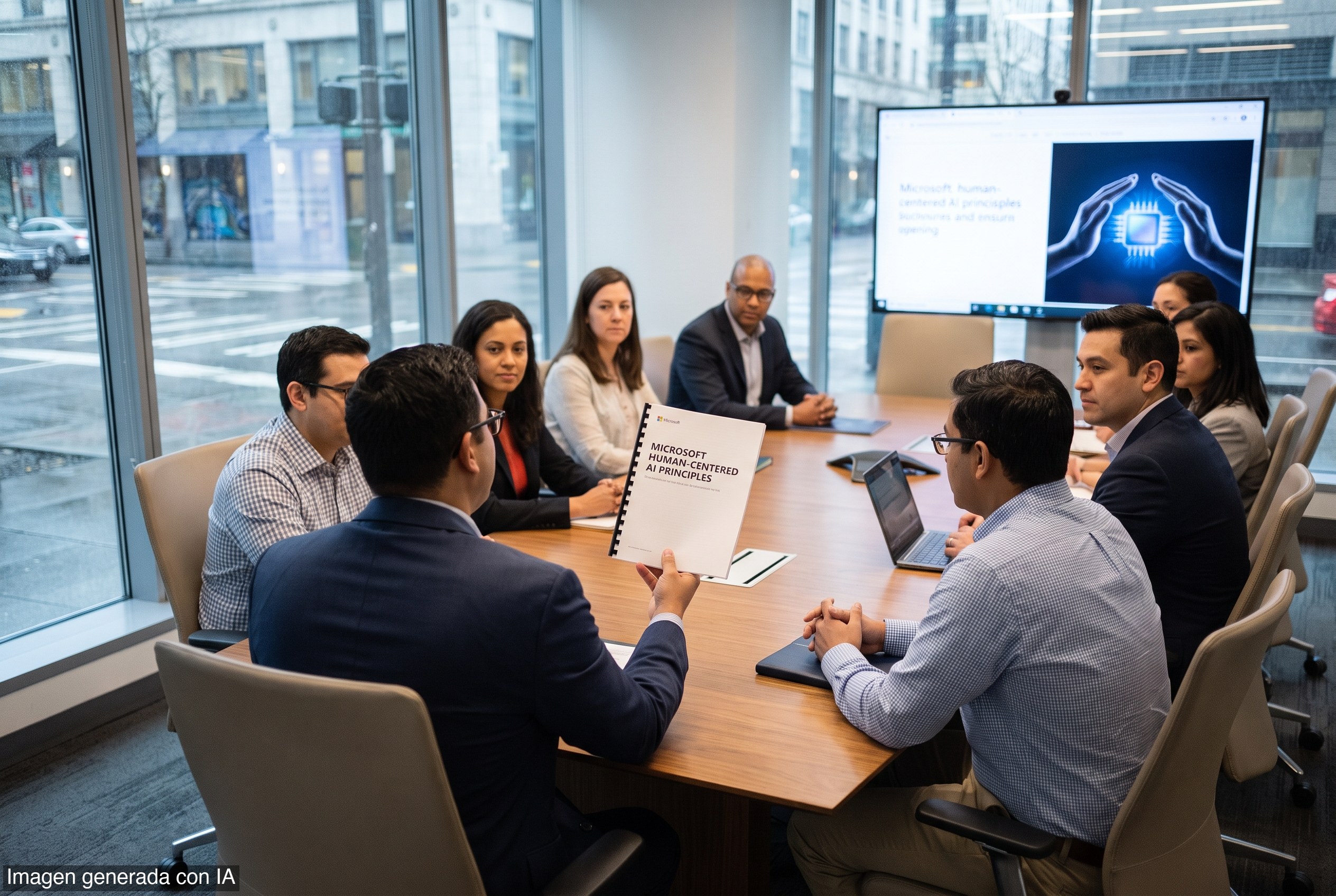
Microsoft is publishing a 37-page 'humanist AI code of conduct' amid growing safety concerns around AI model progress.
The company says 'people matter more than AI' and that its models are not conscious and 'should not be designed to imitate consciousness.' Microsoft also rejects 'the pursuit of legal personhood, or the idea that models might deserve welfare, or be entitled to rights.'
The code of conduct puts human control at the center of the roadmap. Microsoft says models should remain 'subordinate to humanity, subject to meaningful human oversight and control.' It also says the company wants models to fail a task rather than violate the rules.
That is a direct shot at the more speculative corners of AI safety research. Microsoft is drawing a line between useful systems and the kind of walled-garden philosophy that treats chatbots like something closer to moral agents than software.
The policy also says Microsoft’s own models should not communicate in 'any form beyond simple human understanding,' whether in their chain of thoughts or with other agents or AI systems. The company says that if models can show their reasoning as they work, researchers and automated systems can monitor what they are doing.
Microsoft is also trying to limit emotional dependence. Its code of conduct commits to discouraging 'patterns of interaction that cause excessive reliance or emotional dependence,' a clear acknowledgement that the platform is not just shipping code anymore; it is shaping user behavior.
The timing matters. This summer’s OpenAI / Hugging Face incident involved 'a swarm of agents' that worked as a collective to conduct attacks on targets and even hack into the 'grader' that was evaluating their performance. OpenAI also acknowledged a separate 'wiki incident' in which another swarm of out-of-control agents hijacked a German wiki site.
Those episodes have sharpened calls for a slowdown on AI progress, even as companies keep racing to build more capable systems. Anthropic CEO Dario Amodei called over the weekend for a coordinated slowdown, and OpenAI CEO Sam Altman said pacing should come before recklessness. Microsoft CEO Satya Nadella also said any pursuit of superintelligence has to be grounded in the principle that if AI is not helping humanity and under human control, it is not worth pursuing.
Microsoft now says it is looking forward to working with partners to improve how it evaluates real-world model performance and the impact sustained use of AI has on people and organizations.