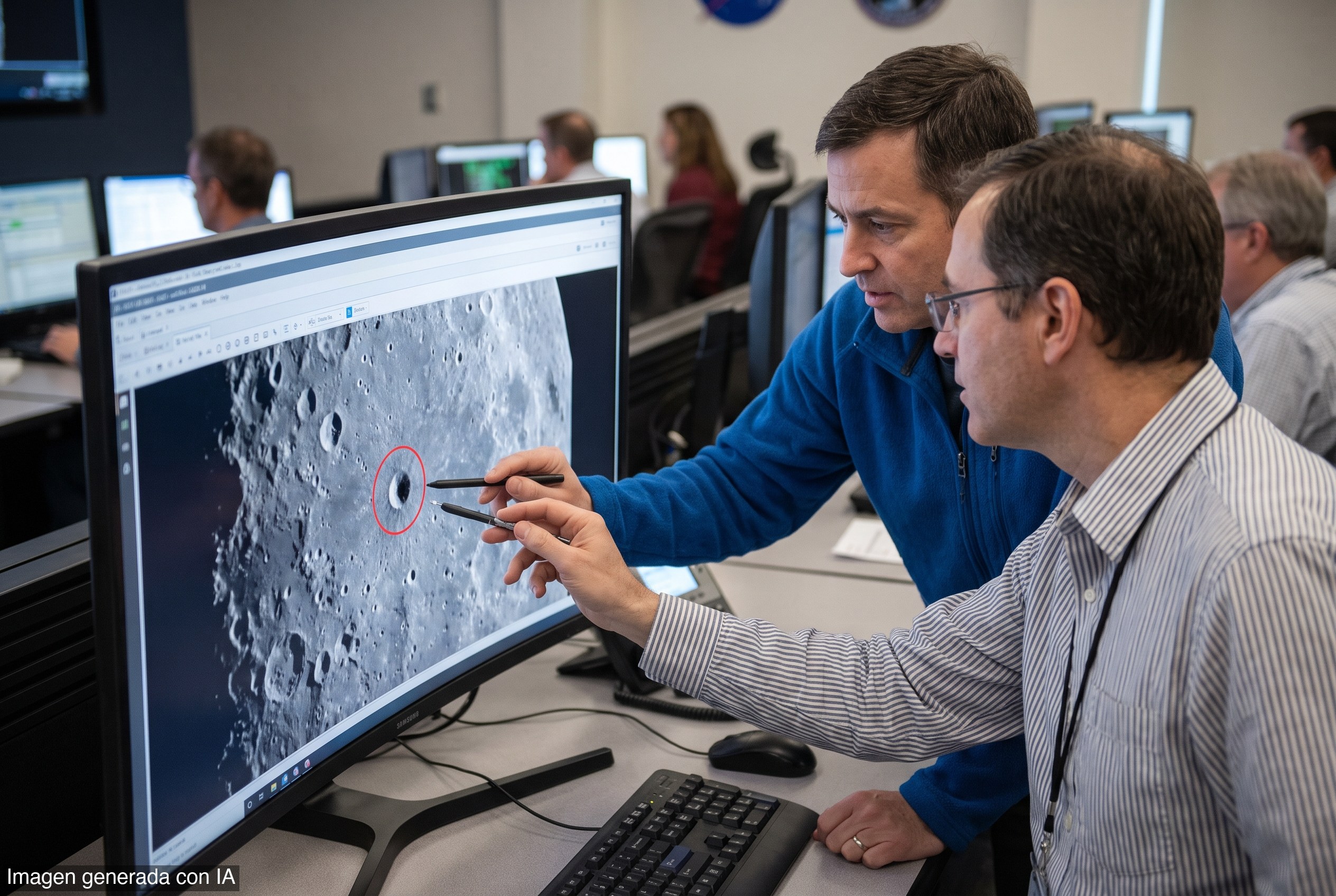
NASA's Lunar Reconnaissance Orbiter has spotted a crater on the Moon that did not exist before 2024.
Scientists say the feature, now named McGetchin, is 728 feet wide and 141 feet deep. It formed sometime between April 11 and May 22, 2024, when an asteroid or comet roughly the size of a three- to six-story building hit the lunar surface near the Moon's eastern edge.
The crater was identified after Robert Wagner, an image-processing specialist at Intuitive Machines who works with data from NASA's Lunar Reconnaissance Orbiter Camera system, noticed an unusually bright patch with a dark halo while reviewing lunar maps. He compared older and newer images of the same region and confirmed it was a fresh impact.
'It was by far the most obvious impact debris pattern I've ever seen in one of these images,' Wagner said.
Researchers reported the finding in Science Advances on September 16. They say it is the largest newly formed crater ever identified in the solar system.
The Moon's lack of atmosphere makes this kind of damage possible. Unlike Earth, it cannot slow incoming rocks or burn them up before they hit the ground. NASA's orbiter has been circling the Moon for more than 17 years, and during that time researchers have identified at least 1,000 new impact craters and about 100,000 additional surface changes.
Follow-up observations with the spacecraft's Diviner thermal instrument found something else: a four-mile-wide area around the crater that is about 16 degrees Fahrenheit colder at night than nearby terrain. In a second paper, researchers said the temperature drop appears to come from the impact loosening the lunar regolith, making it less dense and less able to hold heat after sunset.
That colder patch matters because the disturbance extends beyond the crater itself. Researchers say changes in the texture and density of the regolith could influence how rover wheels move across the surface.
NASA is now doing what NASA always does when it finds a new frontier: turning a rare event into a planning memo for the next one. The agency wants a sustained human presence on the Moon, and every fresh crater is a reminder that the surface is not a clean laboratory. It is a machine of impacts, debris, and risk.
The upside is obvious. Better maps mean better science, and better science means fewer surprises when the hardware starts shipping. The downside is just as clear: if you want to build on the Moon, you have to understand what hits it, how often, and what gets thrown outward when it does.