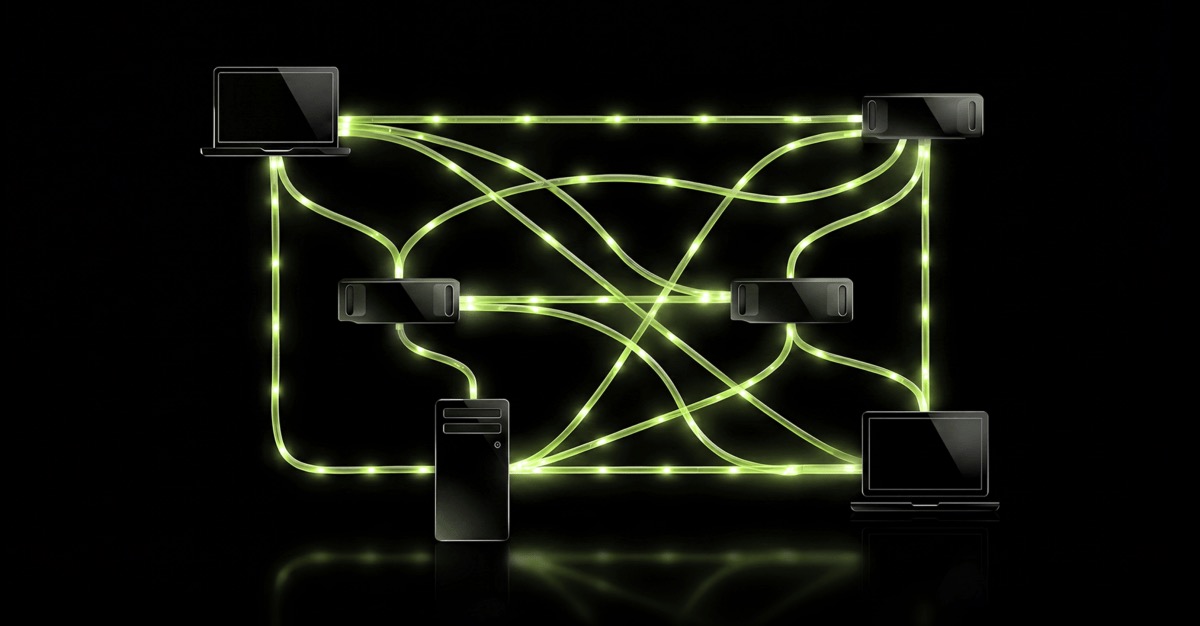
Nvidia used IFA 2026 to announce Personal AI Router, or PAIR, a free, open-source tool that finds compatible PCs on a home network, pairs them, and puts their idle GPU cycles to work on local AI inference through tools like Ollama and LM Studio.
Read the changelog before you assume it's hardware: PAIR is not a router in any physical sense. It's software that discovers devices, connects them, and hands out processing jobs across whatever is sitting unused. Compatible gear includes Nvidia GeForce RTX 20-series cards and newer, RTX Pro GPUs, DGX Spark systems, and Apple M4 chips or newer. It runs on Windows, Linux, and macOS, through both graphical and terminal interfaces, and is available today in beta.
The mechanics are straightforward. An AI agent breaks a task into smaller subagent jobs, and instead of those subagents fighting over one GPU, PAIR routes the work to whichever machine on the network is idle and capable. Nvidia says the system adapts in real time, so if someone starts gaming on the desktop, PAIR reroutes around it. Security runs on a six-digit pairing code plus mTLS, an encrypted, mutually authenticated channel between devices.
Nvidia product manager Seth Schneider offered a sample household to illustrate the pitch: a parent with an RTX Spark laptop and DGX Spark desktop, another with an RTX 5090 laptop, a gaming desktop for one kid, a MacBook Pro for the other. Schneider put that setup's underutilized compute at roughly 165 teraflops, calling it 'a treasure trove of free tokens just sitting in homes today,' even after accounting for electricity costs. Nvidia notes more than half of US households already own two or more PCs. Asked who the tool is actually for, Schneider was more modest: most PAIR users will probably have just one laptop and one gaming PC.
Alongside PAIR, Nvidia announced that three AI agent apps — Perplexity Portable Computer, Hermes Agent, and OpenClaw — will get simplified local setup on Windows with Nvidia GPUs, cutting down the manual configuration usually required to get an agent running locally.
Here's the thing. The 165-teraflop household is a demo scenario, not a median American living room, and Nvidia picked the numbers Nvidia wanted you to hear. But strip out the marketing and the underlying move is sound: this is compute you already paid for, running AI you control, on hardware that sits in your house rather than in somebody else's data center. No subscription meter, no cloud provider deciding what your query costs or where your data lands.
That's the actual news here — not the teraflop math, but the option itself. A free, open-source tool that lets people extract more value from property they already own, instead of renting capacity from a hyperscaler, is exactly the kind of decentralization the AI boom needs more of. Nvidia still profits either way, since more GPUs sold means more PAIR nodes. Fine. The demo is not the product, but the incentive to keep your compute local, and out of someone else's walled garden, is worth taking seriously regardless of who's selling it.