Here's the thing. Apple spent years telling photographers that computational magic was the answer, and now it's handing them a histogram.
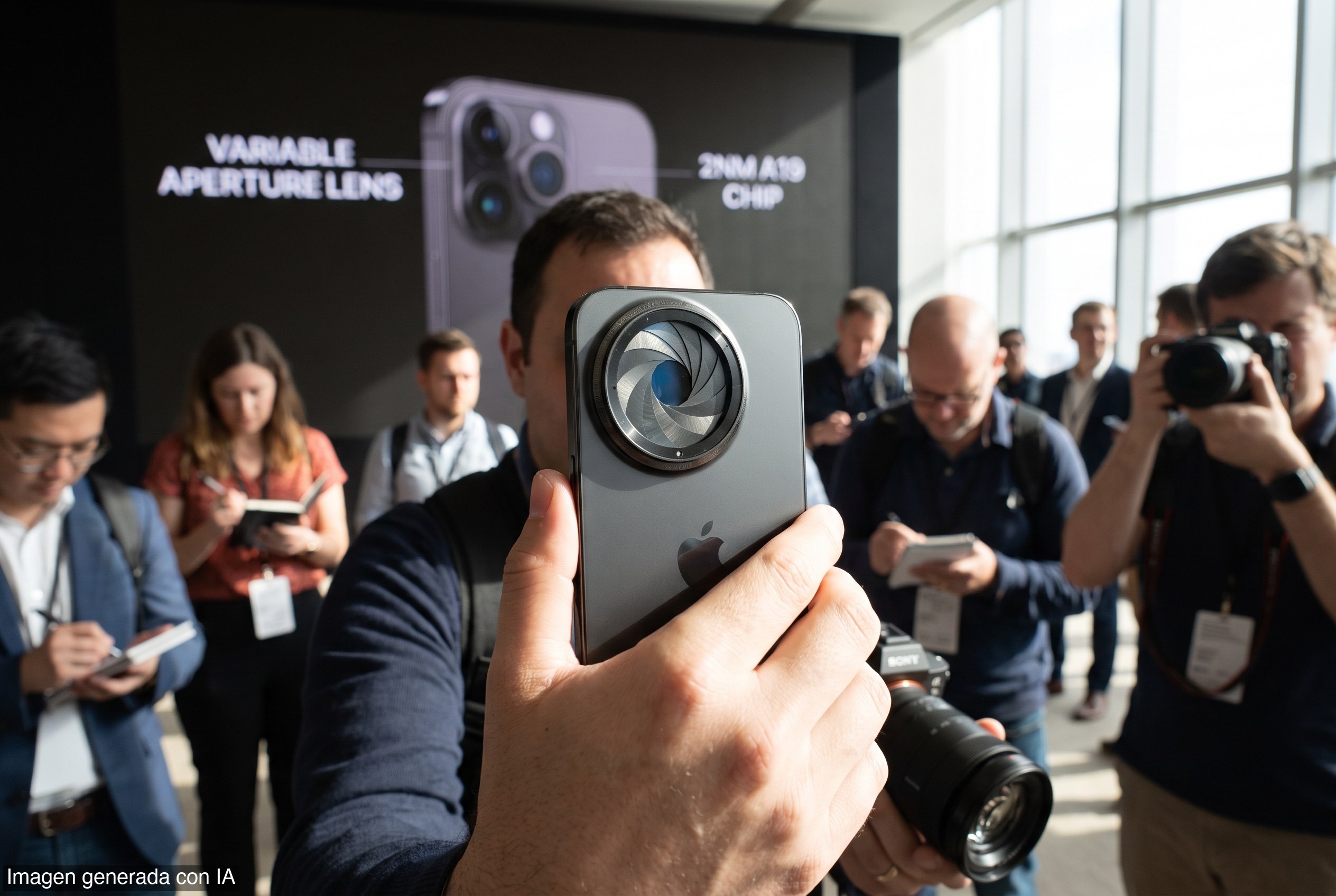
The iPhone 18 Pro, announced at Apple's event in Cupertino, leads with a variable aperture on its 48MP main Fusion camera — four manual stops: f/1.48, f/1.8, f/2.8, and f/4.0. Apple says the blades are laser-cut to allow fluid transitions, which matters because shrinking aperture mechanics down to phone-sensor scale is genuinely hard engineering. The Samsung Galaxy S9 had a dual-aperture system years ago, and Xiaomi has played in this space too, so Apple isn't first. But the execution here, paired with full Pro controls, is a different proposition.
In automatic mode, the aperture opens and closes to manage exposure without touching shutter speed — useful for action shots in low light where you want sharpness without grain. In Pro mode, you get manual aperture, shutter speed, ISO, and white balance, plus a histogram. A histogram. On a phone. That's a feature missing from some dedicated cameras, as Engadget's camera reviewer noted.
The persistent subject tracking for video and photos is another headline item. Apple says it will lock onto a person and keep tracking even if they disappear momentarily behind someone in a crowd. Canon introduced comparable functionality on its $4,500 EOS R5 II mirrorless camera not long ago. The iPhone 18 Pro is now in that conversation at a fraction of the price.
The new Apple Reference Image mode is the sleeper feature. Shoot in Reference mode and the camera captures signed sensor data that Private Cloud Compute develops into an 'unalterable reference image' — viewable in the Photos app beside the main image, like a digital negative. The point is provenance: you can check whether a photo has been stolen or altered. In an era of AI-generated everything, that's a meaningful trust layer.
On the silicon side, the A20 Pro is Apple's first 2nm chip for iPhone. It carries a 6-core CPU with two performance cores rated up to 20 percent faster, four efficiency cores, and a 7-core GPU with up to 40 percent improved graphics performance. The Neural Engine is described as two engines on one chip. Apple also flagged improved thermals — a quiet acknowledgment that heat management has been a real-world complaint.
The 18 Pro and Pro Max are slightly smaller than their predecessors. The Dynamic Island is a bit smaller too. New color: burgundy. Storage goes up to 2TB. The Pro starts at $1,199, the Pro Max at $1,299. Preorders open September 12; the phone ships September 18.
The demo is not the product, but the product here looks like a real camera that also makes calls.
What Apple is doing with the 18 Pro is a quiet rebuke of the AI-everything pitch that has dominated smartphone marketing for two years. Manual controls, signed image data, and aperture mechanics are features that respect the user's judgment rather than replacing it. Free-market competition works: Samsung and Xiaomi pushed variable aperture first, Canon pushed subject tracking, and Apple has now synthesized all of it into a single device at a price that undercuts dedicated camera systems by thousands of dollars. That's the innovation cycle doing exactly what it's supposed to do.