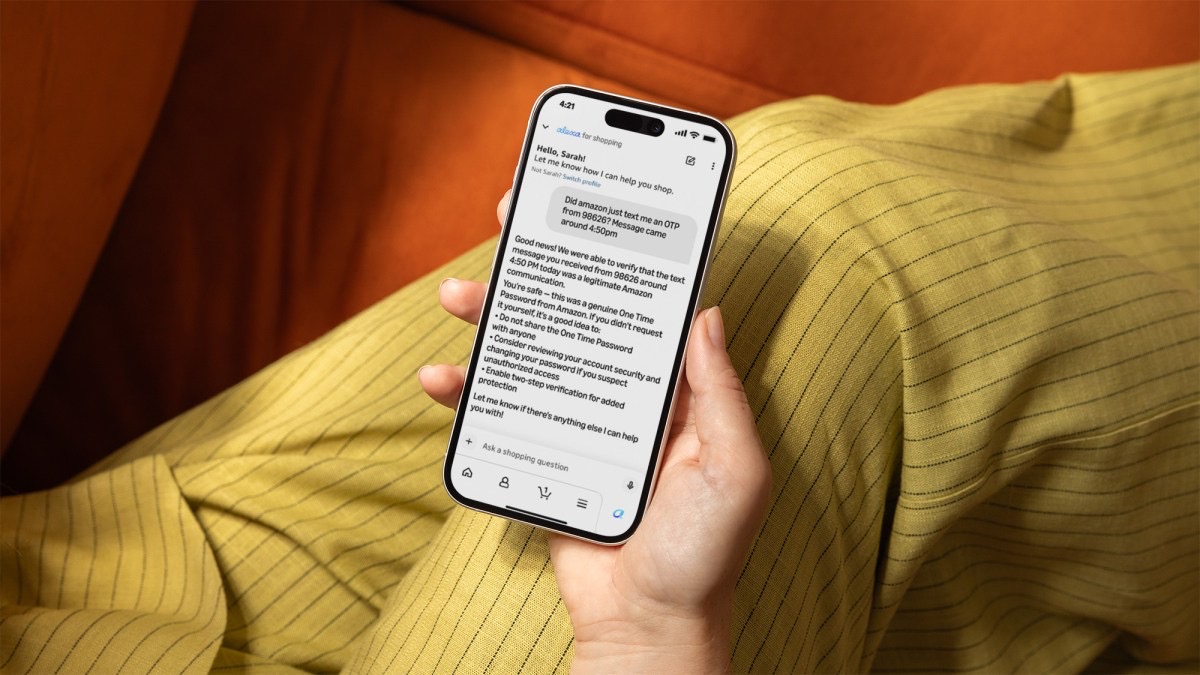
Amazon announced Wednesday that its Alexa for Shopping assistant can now tell customers whether a message claiming to be from Amazon is legitimate or a scam, according to TechCrunch.
The company said roughly 360,000 customers a year contact its support team just to ask if a message is real. Now they can ask the AI instead.
Here's the thing: the mechanism is simple. Amazon says the assistant checks a suspicious message against 'a record of every message Amazon has sent,' according to The Verge, while also analyzing sender information, content, formatting, timing, and metadata. Amazon told The Verge the assistant will only confirm a message is genuine if it's 'completely certain.'
An example Amazon shared shows a customer asking Alexa for Shopping, 'Did Amazon just text me an OTP from 98626? Message came around 4:50pm.' The assistant replies: 'This was a genuine One Time Password from Amazon.' If the system decides a message isn't real, it tells the customer to check their orders in the app and contact support directly.
This builds on a feature Amazon launched earlier this year: an email address, verify@amazon.com, that lets anyone forward a suspicious message and get a reply confirming whether it's authentic. Amazon also runs an online form on its support site that does the same thing.
The scam categories Amazon says it's targeting include fake order confirmations, Prime renewal alerts, account suspension warnings, package delivery notifications, and job scams, per TechCrunch.
Amazon says the system will keep improving as customers flag more suspicious messages, feeding the AI more examples to work from. The rollout also lands alongside an unrelated 'Update Me When' feature that alerts shoppers to new product drops from favorite brands or authors.
Worth noting: this is a private company solving a private-company problem with its own tools and its own money, not a mandate handed down by a regulator. Amazon built the fraud detector because 360,000 annual support calls is a cost center, and a company that doesn't fix that cost center loses customers to whoever does.
That's the free-market case for AI moving faster than legislation here. No agency drafted rules for 'message authenticity as a service' before this shipped. Amazon simply pointed compute at a problem its own customers were flagging and put a product in front of them. Whether it actually cuts scam losses is a question of results, not intentions — and Amazon, unlike a regulator, has every incentive to make sure it works, since its brand is the one being impersonated.